Administrative coordinator wanted

Our wonderful Ania Jasczak, the administrative coordinator for the Dioscuri Centre, has decided to move to pastures new. We have therefore an opening for the position of admin coordinator.

The ideal candidate should be fluent in both Polish and English, and have experience in admin work relevant for scientific projects: budget planning, purchasing equipment and consumables, recruitment, coordinating meetings with external partners.

More information (in Polish) and how to apply can be found here:
https://lnkd.in/e4Bg6cEG

Deadline for applications: 11 May 2023.

Soft- and biological-physics Early-Career Researcher meeting – 23/02/2023

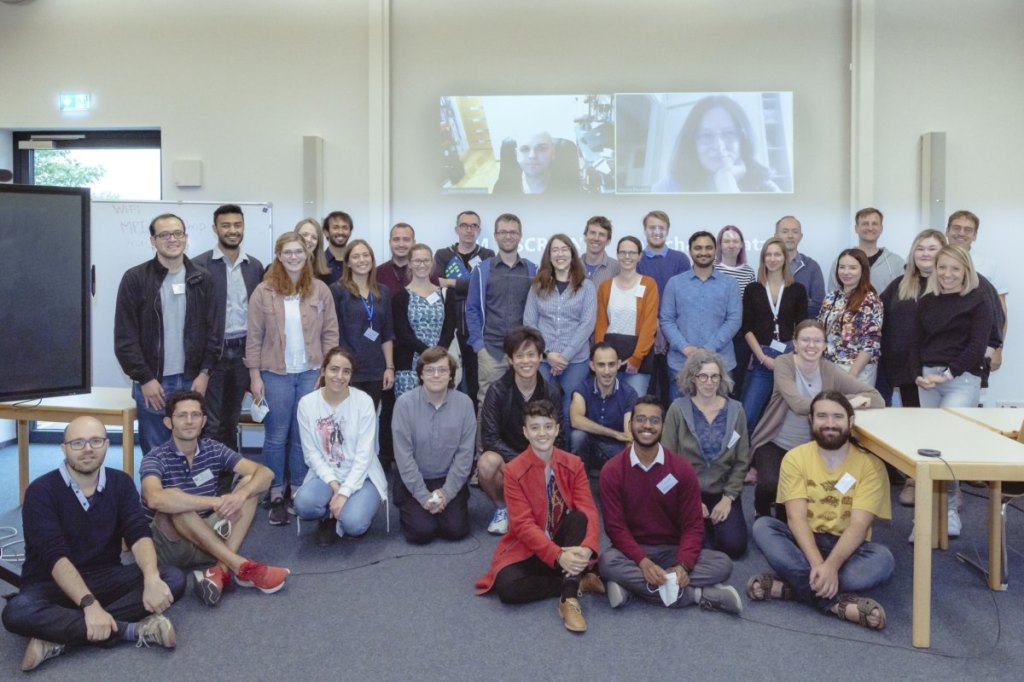
We are organizing a one day in-person meeting for early-career researchers (ECRs, PhD students and postdocs) working on soft-matter and biological physics/chemistry in our institute. The agenda of this meeting is ECR-driven and based on a survey done among the ECRs from different groups in our institute at the end of 2022.

The objectives of the meeting are

  • the ECRs get to know each other and see if they have any shared interests,
  • get a broader view of career development options by listening to PIs/CEOs who followed different career paths.

Venue: Main Lecture Theatre (“Aula”), admin building no. 9, IChF Kasprzaka 44/52, 01-224 Warszawa

Schedule: 

8.15 – 8.45       uploading presentations 

9:00 – 11:00    short talks by ECRs – 5+2 

11:00-11:30     coffee break 

11:30-13:00     short talks by ECRs – 5+2 

13:00 – 14:00  lunch (pizza) 

Career insights

14:00 – 14:30  Rosalind Allen (Jena)

14:30 – 15:00   Chay Paterson (Manchester)

15:00 – 15:30   Achillefs Kapanidis (Oxford)

15:30 – 16:00  James Flewellen (Edinburgh University)

16.00 – 17.00   coffee, cake and networking 

First Dioscuri-made preprint

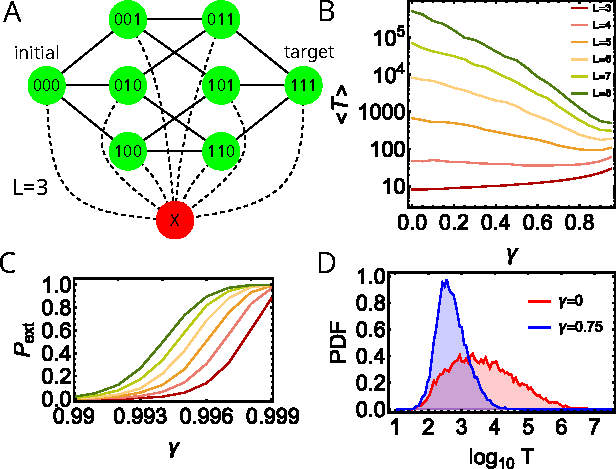
We have finally started drafting papers based on research made exclusively by Dioscuri researchers! Our first preprint paper is Evolutionary adaptation is facilitated by the presence of lethal genotypes,
(Viktoria Blavatska, Bartlomiej Waclaw). It is a theory paper on how biological evolution is affected by lethal mutations that create non-viable organisms. In contrast to the naive expectation, we show that such genotypes actually can speed up evolution in some scenarios.

A simple model of cancer cell response to chemotherapy

Remember what Pragyesh found regarding the response of glioblastoma cells to chemotherapy with temozolomide (TMZ)? Here is it again (see the picture on the left): cells respond to the drug with a delay. Now, thanks to the computer simulation (middle- and right-hand pictures) developed by Saumil Shah (a visitor from Ploen) we can model this process mathematically.

The model has been inspired by a mathematical model of multi-stage cell cycle and an agent-based model. We have added treatment-driven death and calibrated the model against our data. In the model, cancer cells go through different cell cycle stages and are affected by the drug during only a specific stage in the cell cycle. This makes the model more biologically realistic than the simple birth-and-death process used to model the evolution of resistance to chemtherapy, which is what we ultimately want to do.

This research has been supported by the POLS programme, funded through Norway Grants.

New team member

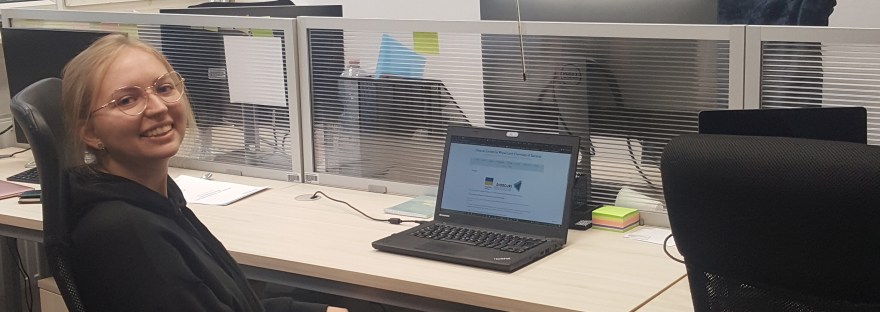
Despite the gloomy weather outside, a very warm welcome to our new team member – Klaudia Staśkiewicz! She will work in the Dioscuri as a technical specialist helping our team with their experiments. Klaudia is a biologist with experience in microfluidics and we will certainly enlist her to projects that combine microbiology and microfluidics, such as our recently started OPUS-funded project.

Dioscuri – MPI Evolutinary Biology meeting

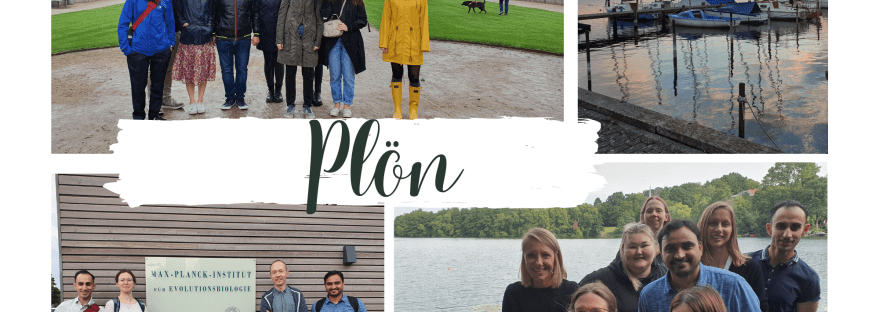
Last week we spent a very intense 5 days visiting our collaborators in Ploen in the north of Germany. Amanda Azevedo and Michael Raatz – local organizers who coincidentally also spent some time at the Dioscuri Centre – put up together a very nice programme of scientific talks, discussion sessions, and a few social events.

This was the first time most of our group travelled together to a meeting, because we started the Dioscuri Centre in the midst of COVID-19.

We came back to Warsaw full of news ideas about possible joint projects.

Photo credits: Michael Hesse.

Only one day until our group trip to Ploen

This Sunday the whole Dioscuri Centre is going to Ploen (north of Germany) to participate in a research workshop (5-9 September). This is the first time since the opening of our centre that we can physically visit our collaborators at MPI Evolutionary Biology. We have already had a few guests from Ploen (Amanda, Michael) and we are now reciprocating. Hopefully, we will bring in only good vibes and not the universally-dreaded infectious disease!

Apart from talks by our group members and the local researchers, we will also have a scientific speed-dating session and dedicated slots for one-to-one and group discussions.

Many thanks to Amanda Azevedo and Michael Raatz (local researchers) as well as Ursula Kruetzfeld and Maren Lehmann for organizing the workshop.

Here are some details of the meeting.

Response of cancer cells to chemotherapy

Pragyesh did a clonogenic assay to assess change in the number of colonies formed by different cell lines in response to various doses of temozolomide (TMZ) treatment.

The graph above shows the change in the number of the colonies formed as compared to the DMSO-treated cells. We further treated cells with various doses of TMZ and assessed the change in their number over time using live-cell microscopy. To achieve this, Ilyas has developed an algorithm to quantify the number of cells. Though this algorithm is still a “work in progress”, it works quite well and shows that cells do not respond to the drug immediately after its application:

Rather, a significant delay is observed for all concentrations of the drug. Interestingly, this is very similar to what we observed for bacteria treated with antibiotics. This is just another example of interesting parallels between the growth of bacterial populations and cancer which we want to explore further.

This research has been supported by the POLS programme, funded through Norway Grants.

“What do you do in your job”

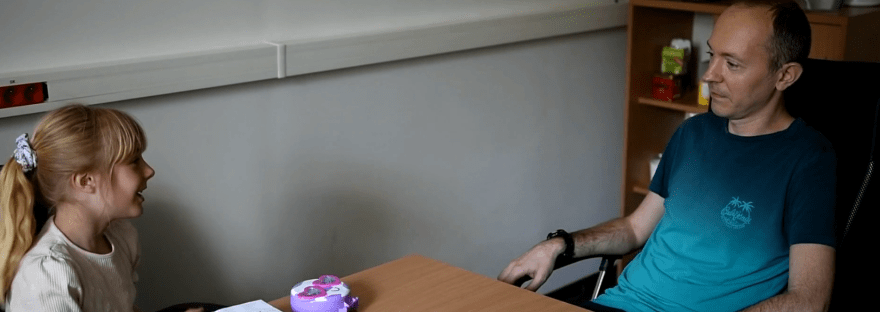
A few weeks ago we recorded a video featuring my daughter and some of the Dioscuri scientists. Julia (8 years old) interviews us about our work. I think everyone will agree that she is the star of this short video! Many thanks to everyone who participated in the production process (Magda, Asia, Pragyesh, Ilyas, Dominik)