We at the 27th Science Picnic!

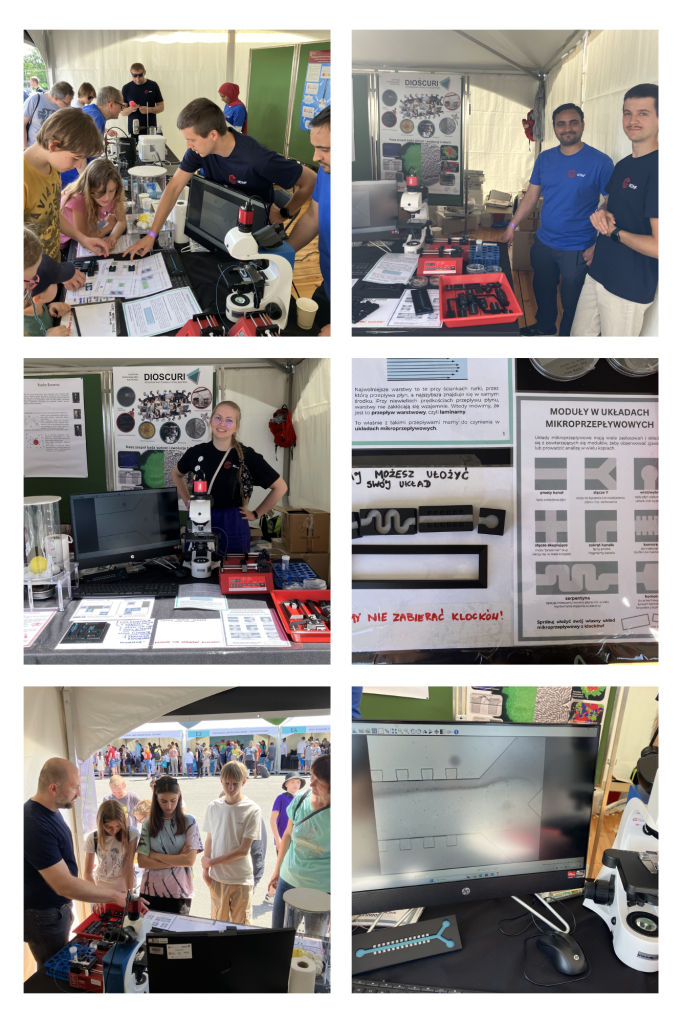
As announced, on June 15, 2024, we appeared at the 27th Science Picnic of Polish Radio and the Copernicus Science Center. Our stand could be visited from 11 a.m. to 8 p.m.
All visitors, including the youngest, were very enthusiastic about our “Extraordinary World of Microflows”, where they could learn about the key physical phenomena that determine the properties of flow on such small scale. Laminar flow, diffusion, and Brownian motion the Picnic participants observed on a large screen showing an image of a microfluidic channel under a microscope, they also learned how we prepare such systems in laboratory conditions, and they even created their own microfluidic systems from blocks. A puzzle referring to the construction of such systems from modules with blocks was very popular.

Thank you for your great interest and we are looking forward to the next edition of the picnic, which we will certainly be attending.
“Unbelievable! Or about trust in science” 27th edition of Science Picnic in Warsaw

We invite you to the 27th edition of Science Picnic of the Polish Radio and the Copernicus Science Center. Theme: “Unbelievable! Or about trust in science”
We will try to show all science enthusiasts the phenomenon of “The Extraordinary World of Microflows” that stirs the imagination.
You will be able to observe the non-intuitive behavior of fluids in the microfluidic channel live in the image from a camera connected to the microscope. We strongly encourage you to interfere with the experiment. See for yourself what will happen when you stop or change the speed of liquid flow in the channel. See you on June 15 at PGE National Stadium in Warsaw!

Dioscuri Centres at the German Embassy

On 11 May 2024 our Centre participated (along 5 other Dioscuri Centres) in the German embassy open doors day. We had a nice stand in the embassy building, which very quickly got crowded with the general public.

We presented an experiment on mixing water and dye-stained water in a microfluidic channel and in a “macrofluidic” Y-type junction with some tubes and syringes attached. A non-intuitive outcome of this experiment (the liquids mix in the macroscopic juction but not in the micro-fluidic junction) is the result of a lack of turbulence in microfluidic flows. This is actually a problem for us as we work a lot with microfluidics and would like to be able to mix different liquids such as a bacterial growth medium and an antibiotic. Fortunately, others have found a way of achieving this, which we can use.

We also had two computer games: “Epidemic!” which is a basic simulator of a COVID epidemic I wrote a few years ago (the game can be played here), and a newer game “Beat the gliobastoma” (click here for the English and Polish versions) in which the objective is to cure a virtual patient who has glioblastoma – a type of a brain cancer. We have a project on glioblastoma chemotherapy which is what inspired this game.

The games (especially the cancer game) were a smasher, especially among the young audience as you can see in the pictures below.

Many thanks for the staff from the German Embassy (in particular Tomasz Wałkuski and Joanna Jones) for inviting us again!

And especially warm thanks to Ilyas, Joanna, Klaudia, and Patrycja for helping me out with preparations (Klaudia, Patrycja, Joanna), beta-testing the games (Ilyas) and manning the stand (Ilyas, Joanna, Patrycja).

European Picnic at the German Embassy with Dioscuri Team!

On the occasion of Europe Week, the embassy of the Federal Republic of Germany invites you to a family picnic on Saturday, 11 May. Dioscuri team will be there and present methods using in labs including microfluidics (interactive demonstration) and computer simulation (in a form of game “Epidemy” and “Cancer therapy simulator”). Let’s meet in the embassy gardens, entrance from Jazdów Street.

Our first high-profile paper made exclusively by the Dioscuri team members has just been published in PNAS!

The work of Witold Postek, Klaudia Staśkiewicz, Elin Lilja, and Bartlomiej Waclaw  scheds new light on how the physical structure of surfaces influences the growth and evolution of bacterial biofilms.

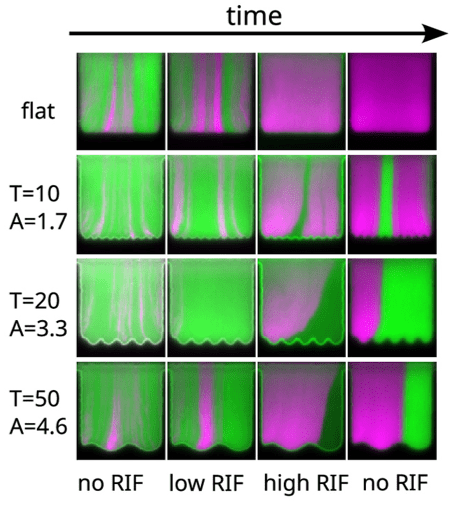
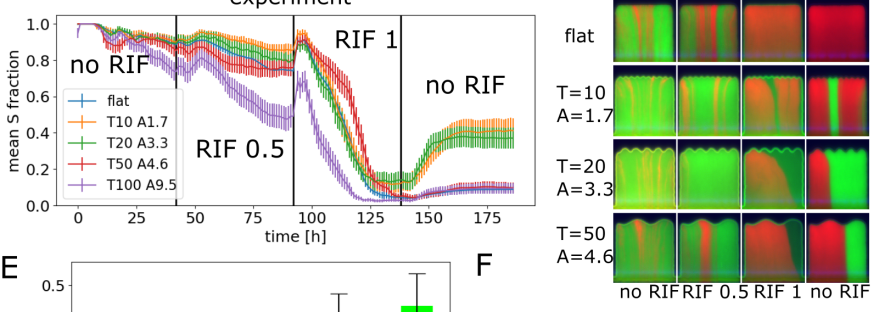
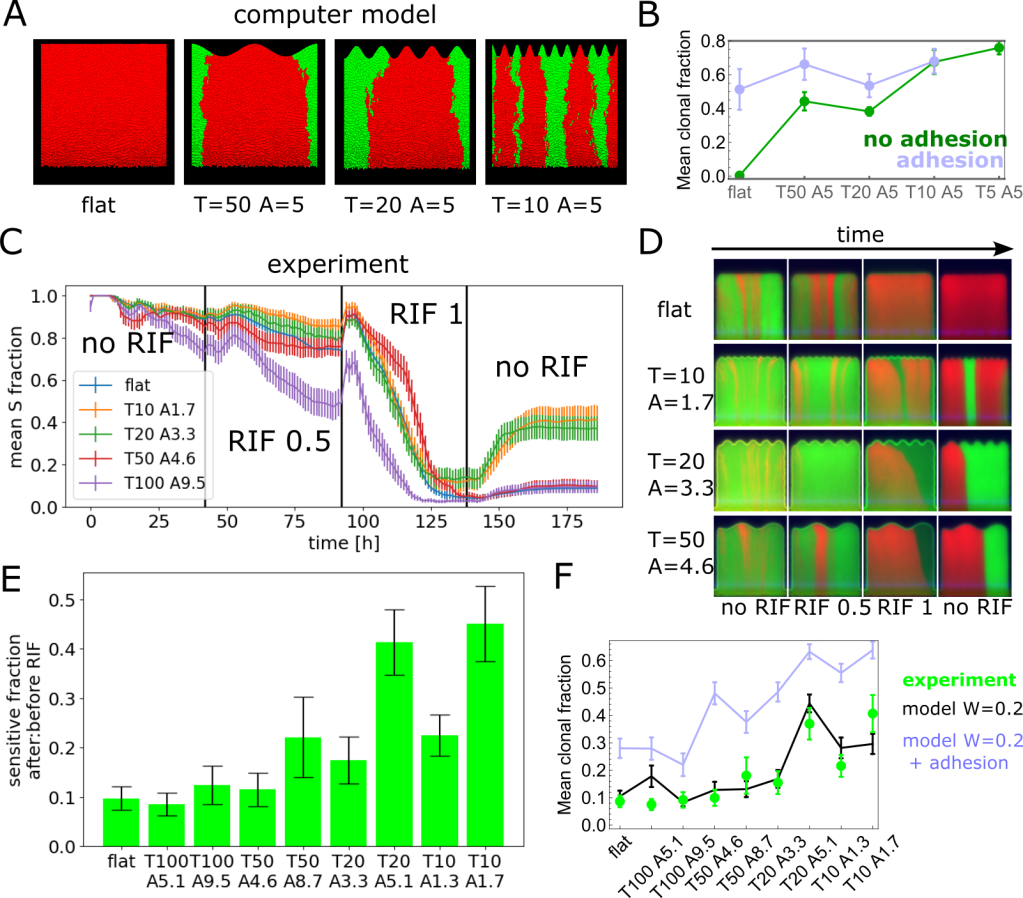
We show that corrugated surfaces inhibit the spread of new genetic variants in biofilms. In particular, antibiotic resistant mutants that occur in biofilms growing on corrugated surfaces form only small local populations when exposed to sub-lethal concentrations of antibiotics. This is in contrast to biofilms on flat surfaces on which such resistant variants spread quickly and take over the entire biofilm.

This limited spreading is achieved by using the physics of the growing biofilm against it: corrugations redirect the “biomass flow” in the biofilm, which limits the invasive potential of clonal “sectors” to invade nearby sectors.

We hope that this research will help design surfaces that enable a better control of the evolution of bacterial communities, and find applications in medicine and industry.

A new preprint on biofilms on patterned surfaces

We have just posted our latest work in biological physics on arXiv. The article “Substrate geometry affects population dynamics in a bacterial biofilm“, co-authored by Witold Postek, Klaudia Staśkiewicz, Elin Lilja, and Bartlomiej Waclaw, combines microfluidic experiments and computational models to show how biological evolution and population dynamics of bacteria can be controlled by micro-patterning the surface on which the bacteria form a colony (a biofilm).

We introduce fluorescent bacteria into micro-wells with a corrugated surface, in which the bacteria develop biofilms, and track their dynamics using microscopy. We show that surface undulations arrest the spreading of faster-growing (fitter) variants of bacteria, which has potential implications for both medicine (antibiotic resistance) and industry (engineered microbial communities).

A postdoctoral researcher needed

Are you ready to join a passionate team and contribute to the project “Transition from genetic to phenotypic antibiotic resistance in de novo bacterial mutants”?

We have one postdoctoral position available. Don’t hesitate to apply!

For more information see Jobs tab.

Warsaw Science Fair 2023

Last saturday the Dioscuri Centre together with a few other groups from IChF participated in the Science Fair in Warsaw. This is one of the largest events of this kind in Central Europe; the fair attracts huge crowds (tens of thousands) and lasts from 11am until 8pm. Our group prepared two demonstrations: live imaging of the process of killing bacteria (E. coli) with ethanol in a microfluidic channel, and a set of Petri dishes with different letters and symbols painted with fluorescent paints. The first was to demonstrate what happens when you use ethanol for disenfection – as you can imagine, we had a few interesting comments on this from the public. The latter experiment demonstrated the principles of fluorescence, thought it turned out to be also a magnet for children who just wanted to see what we hid in a “black box” (a safe blue-light illuminator to make the plates glow).

Many thanks to Asia, Klaudia, Ilyas, Pragyesh, Jarek who helped organize this event and tirelessly presented the experiments to the public!

A (belated) welcome to a new Dioscuri member

I almost forgot that we have a new team member – Jaroslaw Pankowski – a biologists who will work on an OPUS-funded project about the genotype-to-phenotype transition in bacteria. Jarek started already in March and has made good progress since then regarding creating a genetically engineered strain of E. coli. The strain will enable us to optically image the emergence of new mutations that confer resistance to antibiotics.