It is with a heavy heart that I announce the closing of our Dioscuri Centre. Although we were offered a funding extension (thank you MPG and NCN), after careful reflection I have decided not to accept it, mainly for personal reasons.
This decision was not made lightly. Over the years, the Centre has been a place of collaboration, discovery, and shared purpose. I am deeply grateful to everyone who has supported us — my co-workers, scientific partners, and friends. Your dedication and enthusiasm have been at the heart of everything we accomplished.
With heartfelt thanks and warm regards, Bartek Waclaw – leader of The Dioscuri Centre
On 11 May 2024 our Centre participated (along 5 other Dioscuri Centres) in the German embassy open doors day. We had a nice stand in the embassy building, which very quickly got crowded with the general public.
We presented an experiment on mixing water and dye-stained water in a microfluidic channel and in a “macrofluidic” Y-type junction with some tubes and syringes attached. A non-intuitive outcome of this experiment (the liquids mix in the macroscopic juction but not in the micro-fluidic junction) is the result of a lack of turbulence in microfluidic flows. This is actually a problem for us as we work a lot with microfluidics and would like to be able to mix different liquids such as a bacterial growth medium and an antibiotic. Fortunately, others have found a way of achieving this, which we can use.
We also had two computer games: “Epidemic!” which is a basic simulator of a COVID epidemic I wrote a few years ago (the game can be played here), and a newer game “Beat the gliobastoma” (click here for the English and Polish versions) in which the objective is to cure a virtual patient who has glioblastoma – a type of a brain cancer. We have a project on glioblastoma chemotherapy which is what inspired this game.
The games (especially the cancer game) were a smasher, especially among the young audience as you can see in the pictures below.
Many thanks for the staff from the German Embassy (in particular Tomasz Wałkuski and Joanna Jones) for inviting us again!
And especially warm thanks to Ilyas, Joanna, Klaudia, and Patrycja for helping me out with preparations (Klaudia, Patrycja, Joanna), beta-testing the games (Ilyas) and manning the stand (Ilyas, Joanna, Patrycja).
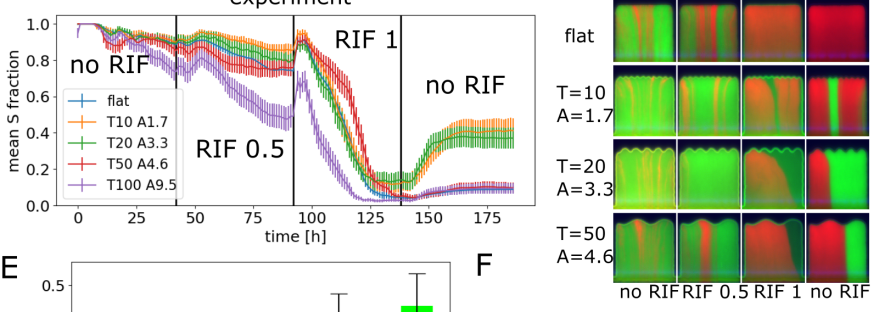
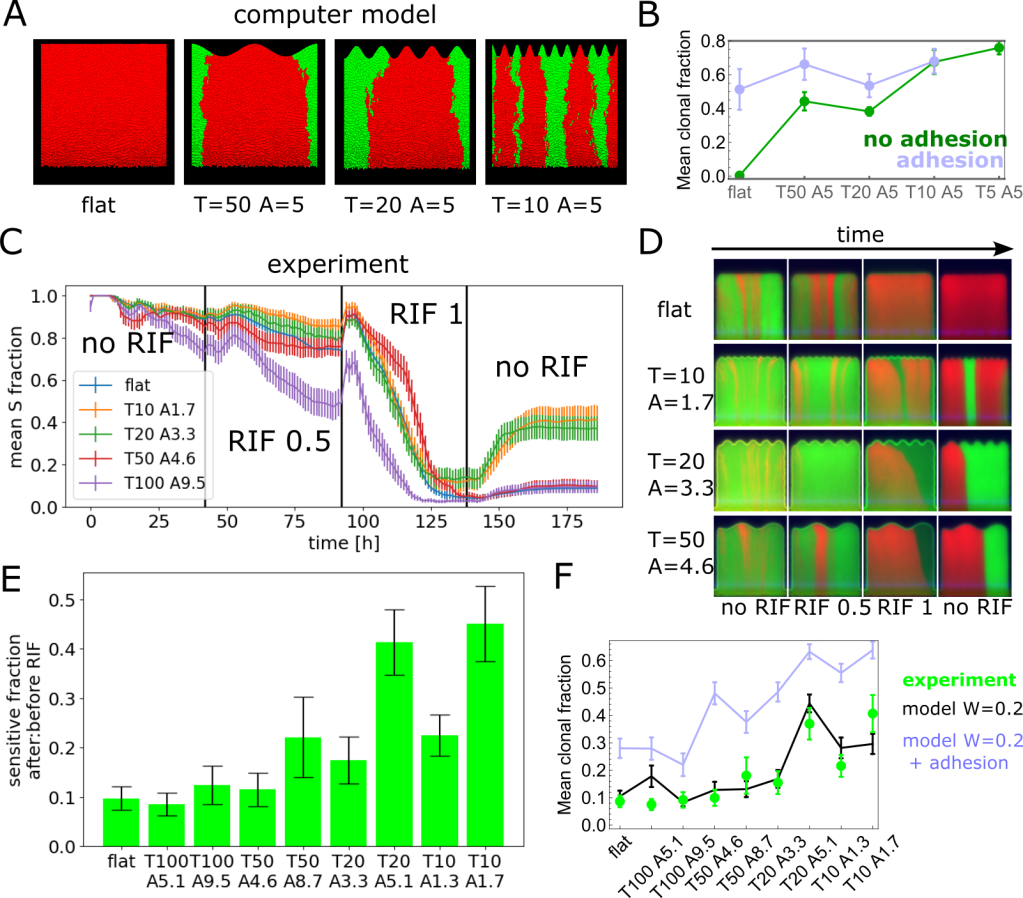
We have just posted our latest work in biological physics on arXiv. The article “Substrate geometry affects population dynamics in a bacterial biofilm“, co-authored by Witold Postek, Klaudia Staśkiewicz, Elin Lilja, and Bartlomiej Waclaw, combines microfluidic experiments and computational models to show how biological evolution and population dynamics of bacteria can be controlled by micro-patterning the surface on which the bacteria form a colony (a biofilm).
We introduce fluorescent bacteria into micro-wells with a corrugated surface, in which the bacteria develop biofilms, and track their dynamics using microscopy. We show that surface undulations arrest the spreading of faster-growing (fitter) variants of bacteria, which has potential implications for both medicine (antibiotic resistance) and industry (engineered microbial communities).
Last saturday the Dioscuri Centre together with a few other groups from IChF participated in the Science Fair in Warsaw. This is one of the largest events of this kind in Central Europe; the fair attracts huge crowds (tens of thousands) and lasts from 11am until 8pm. Our group prepared two demonstrations: live imaging of the process of killing bacteria (E. coli) with ethanol in a microfluidic channel, and a set of Petri dishes with different letters and symbols painted with fluorescent paints. The first was to demonstrate what happens when you use ethanol for disenfection – as you can imagine, we had a few interesting comments on this from the public. The latter experiment demonstrated the principles of fluorescence, thought it turned out to be also a magnet for children who just wanted to see what we hid in a “black box” (a safe blue-light illuminator to make the plates glow).
Many thanks to Asia, Klaudia, Ilyas, Pragyesh, Jarek who helped organize this event and tirelessly presented the experiments to the public!
I almost forgot that we have a new team member – Jaroslaw Pankowski – a biologists who will work on an OPUS-funded project about the genotype-to-phenotype transition in bacteria. Jarek started already in March and has made good progress since then regarding creating a genetically engineered strain of E. coli. The strain will enable us to optically image the emergence of new mutations that confer resistance to antibiotics.
Our wonderful Ania Jasczak, the administrative coordinator for the Dioscuri Centre, has decided to move to pastures new. We have therefore an opening for the position of admin coordinator.
The ideal candidate should be fluent in both Polish and English, and have experience in admin work relevant for scientific projects: budget planning, purchasing equipment and consumables, recruitment, coordinating meetings with external partners.
We are organizing a one day in-person meeting for early-career researchers (ECRs, PhD students and postdocs) working on soft-matter and biological physics/chemistry in our institute. The agenda of this meeting is ECR-driven and based on a survey done among the ECRs from different groups in our institute at the end of 2022.
The objectives of the meeting are
the ECRs get to know each other and see if they have any shared interests,
get a broader view of career development options by listening to PIs/CEOs who followed different career paths.
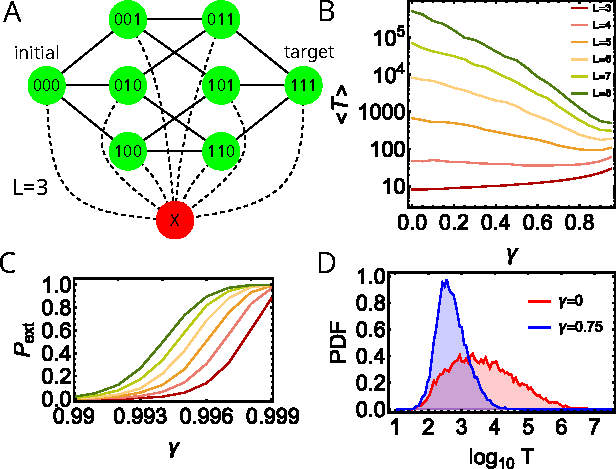
We have finally started drafting papers based on research made exclusively by Dioscuri researchers! Our first preprint paper is Evolutionary adaptation is facilitated by the presence of lethal genotypes, (Viktoria Blavatska, Bartlomiej Waclaw). It is a theory paper on how biological evolution is affected by lethal mutations that create non-viable organisms. In contrast to the naive expectation, we show that such genotypes actually can speed up evolution in some scenarios.
Remember what Pragyesh found regarding the response of glioblastoma cells to chemotherapy with temozolomide (TMZ)? Here is it again (see the picture on the left): cells respond to the drug with a delay. Now, thanks to the computer simulation (middle- and right-hand pictures) developed by Saumil Shah (a visitor from Ploen) we can model this process mathematically.
The model has been inspired by a mathematical model of multi-stage cell cycle and an agent-based model. We have added treatment-driven death and calibrated the model against our data. In the model, cancer cells go through different cell cycle stages and are affected by the drug during only a specific stage in the cell cycle. This makes the model more biologically realistic than the simple birth-and-death process used to model the evolution of resistance to chemtherapy, which is what we ultimately want to do.
This research has been supported by the POLS programme, funded through Norway Grants.






 Dioscuri Centre for Physics and Chemistry of Bacteria