
Funded by the Polish National Agency for Academic Exchange, grant no. PPN/PPO/2019/1/00030/U/0001
Total funding: 2 015 000 PLN
Timeframe: 01/10/2020-30/19/2024
The goal of the project is to develop a mathematical model that could be used to predict the origin of antibiotic resistant mutations in human urinary tract infections.
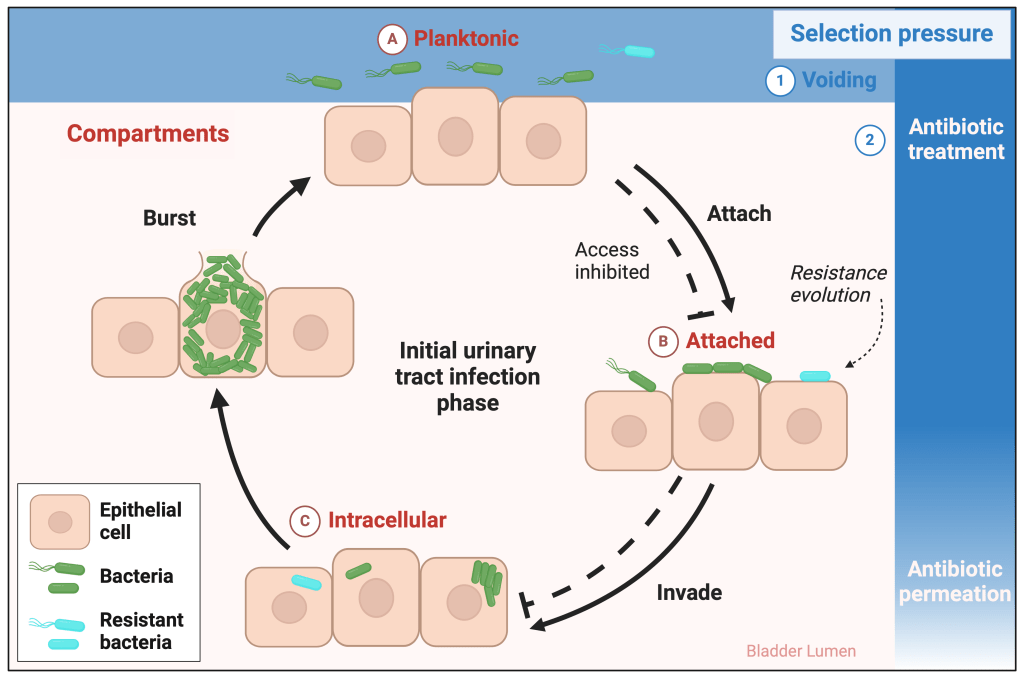
Bacteria are ubiquitous microscopic, single-celled organisms. Many bacteria live on and inside animals and humans, but very few cause diseases. Bacterial infections are usually treated with antibiotics, but resistance to antibiotics is becoming a major challenge. To prevent resistance from emerging and find alternative ways of combatting infections, we must understand population dynamics of bacteria during an infection: how they invade host cells, how resistant mutations arise and spread, and how intracellular bacteria respond to antibiotics. This requires a concentrated interdisciplinary effort.
In this project we take a physics-inspired approach and address these questions through a combination of laboratory experiments and mathematical modelling. We develop experimental model systems of urinary infections together with advanced imaging methods to investigate the population dynamics of bacterial invasion of the bladder epithelium. Mathematical models are used to interpret and direct experiments. The project fills an important gap between in vitro and animal models of infections. It enables quantitative research of bacterial ecology and evolution in an environment closer to the environment of the host than previous works, explore fascinating non-equilibrium physics of intracellular bacterial colonies, and the structure of within-host fitness landscapes.
 Dioscuri Centre for Physics and Chemistry of Bacteria