“Unbelievable! Or about trust in science” 27th edition of Science Picnic in Warsaw

We invite you to the 27th edition of Science Picnic of the Polish Radio and the Copernicus Science Center. Theme: “Unbelievable! Or about trust in science”
We will try to show all science enthusiasts the phenomenon of “The Extraordinary World of Microflows” that stirs the imagination.
You will be able to observe the non-intuitive behavior of fluids in the microfluidic channel live in the image from a camera connected to the microscope. We strongly encourage you to interfere with the experiment. See for yourself what will happen when you stop or change the speed of liquid flow in the channel. See you on June 15 at PGE National Stadium in Warsaw!

European Picnic at the German Embassy with Dioscuri Team!

On the occasion of Europe Week, the embassy of the Federal Republic of Germany invites you to a family picnic on Saturday, 11 May. Dioscuri team will be there and present methods using in labs including microfluidics (interactive demonstration) and computer simulation (in a form of game “Epidemy” and “Cancer therapy simulator”). Let’s meet in the embassy gardens, entrance from Jazdów Street.

Our first high-profile paper made exclusively by the Dioscuri team members has just been published in PNAS!

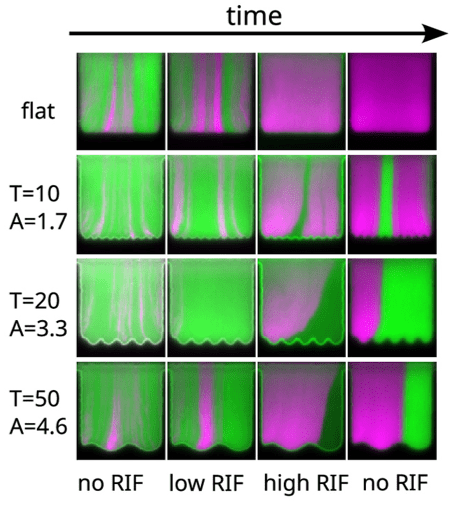
The work of Witold Postek, Klaudia Staśkiewicz, Elin Lilja, and Bartlomiej Waclaw  scheds new light on how the physical structure of surfaces influences the growth and evolution of bacterial biofilms.

We show that corrugated surfaces inhibit the spread of new genetic variants in biofilms. In particular, antibiotic resistant mutants that occur in biofilms growing on corrugated surfaces form only small local populations when exposed to sub-lethal concentrations of antibiotics. This is in contrast to biofilms on flat surfaces on which such resistant variants spread quickly and take over the entire biofilm.

This limited spreading is achieved by using the physics of the growing biofilm against it: corrugations redirect the “biomass flow” in the biofilm, which limits the invasive potential of clonal “sectors” to invade nearby sectors.

We hope that this research will help design surfaces that enable a better control of the evolution of bacterial communities, and find applications in medicine and industry.

A postdoctoral researcher needed

Are you ready to join a passionate team and contribute to the project “Transition from genetic to phenotypic antibiotic resistance in de novo bacterial mutants”?

We have one postdoctoral position available. Don’t hesitate to apply!

For more information see Jobs tab.