A fruitful visit of our guest!

We were pleased to welcome Prof. Ute Neugebauer to the IChF PAN as a guest of the Dioscuri Centre for Physics and Chemistry of Bacteria!

During her visit, Prof. Neugebauer delivered an impressive presentation on her research in the application of Raman spectroscopy for clinical diagnostics. Her work focuses on detecting bacterial infections and understanding physiological interactions in real-time, which is of immense importance for improving rapid diagnostics and personalized therapies.

After the presentation, we had an engaging discussion with Prof. Neugebauer about common research areas. This exchange of ideas has sparked new perspectives and potential collaborations, furthering our mission to explore the interface between physics, chemistry, and biology.

Thank you, Prof. Neugebauer, for sharing your expertise and inspiring our team!

🌟 Celebrating Achievement! đźŚź


We are pleased to share that the poster presented by our colleague, Karolina Drabik, at the recent Microsymposium of the IChF PAN received special recognition from the International Advisory Board! 🎉

This distinction reflects the high quality of research being carried out in our group and highlights the innovative approach to understanding complex biological systems.

Congratulations on this recognition – a great example of dedication to scientific progress. 👏

Dioscuri Centre’s Contributions to the IChF Micro-symposium

Our team actively participated in this year’s micro-symposium organized by the Institute of Physical Chemistry PAS. The event provided an excellent platform to showcase our latest achievements and research.

Our leader Bartlomiej Waclaw delivered an inspiring presentation highlighting Dioscuri research accomplishments in 2024. His talk garnered significant interest and sparked a lively scientific discussion.

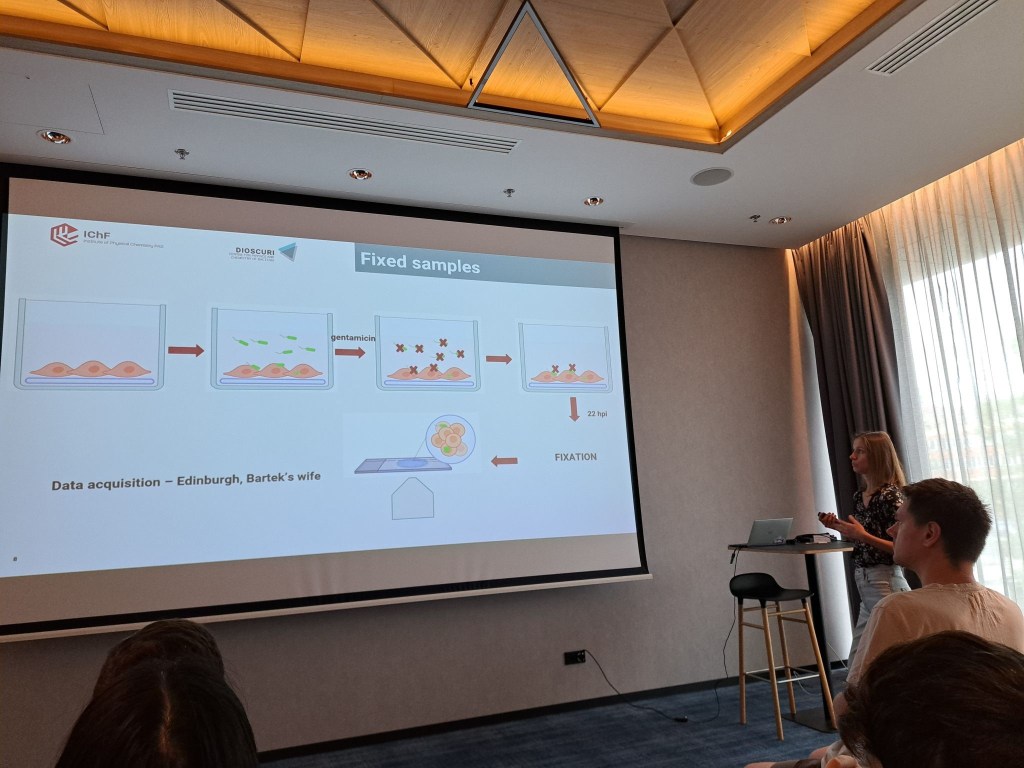
In addition, our researchers – Karolina Drabik and Piotr Ciąćka, PhD – presented their work through posters. Piotr showcased his progress in designing a spinning-disk confocal microscope for live imaging of bacteria, while Karolina shared her work on quantitatively characterizing bacterial attachment to bladder cells and bacterial growth within these cells. Both posters attracted considerable attention, fostering valuable conversations and an exchange of ideas.

We are proud to contribute to the advancement of science and to strengthen connections within the scientific community. Many thanks to the organizers!

Congrats Klaudia! We are happy to have you on the team!

This week, one of our teammates, Klaudia StaĹ›kiewicz, had an opportunity to present her contribution to Dioscuri Centre research at the 1st International Conference on Emergent Functions of Bacterial Multicellularity organized in Berlin as a part of interdisciplinary Priority Program #SPP2389 funded by Deutsche Forschungsgesellschaft (DFG).

She presented the results on the topic of population dynamics in a bacterial biofilm affected by the surface geometry. Our work was appreciated even before the talk being mentioned on a presentation of another participant, and also arised insightful discussions.

We are happy to introduce new scientist to our team! đźŽ‰

Marek, a quantitative biologist, joined us in December through a NAWA – Narodowa Agencja Wymiany Akademickiej Polskie Powroty grant. His research combines mathematical modeling with experimental approaches to unravel the complex dynamics of biological systems, with a particular focus on how cells respond to pathogenic challenges.

At our Centre, he will explore host cell-bacteria interactions using deep learning-based microscopy image analysis. Through this, we aim to support our experimentalists by providing advanced computational tools to analyze and interpret complex biological data, enhancing the accuracy and efficiency of their research.

We’re thrilled to have him on board and look forward to the contributions he will make to our research!

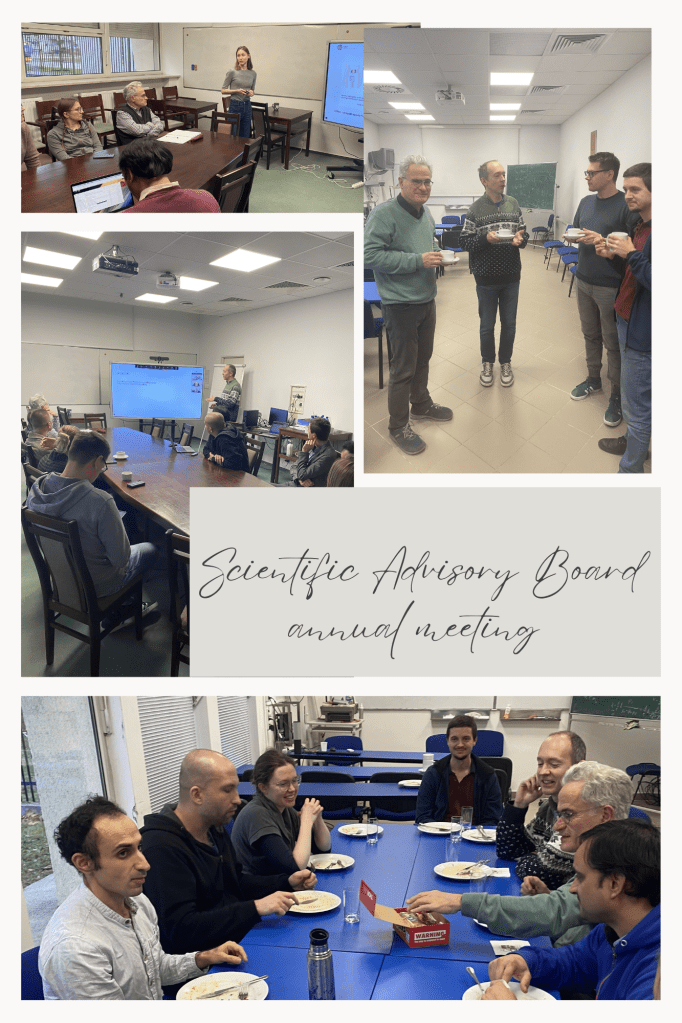
Scientific Advisory Board Meeting

🌟 What an intense but fantastic few days we’ve had! On the 9th and 10th of December, we enjoyed a packed schedule filled with presentations, discussions, and the opportunity to have one-on-one conversations with members of the Scientific Advisory Board.
Our interactions went beyond science—we also had a great time socially, sharing meals at a restaurant, and engaging during lunches and coffee breaks.
This year, Prof. Joachim Krug joined us in person, while Prof. Meriem El Karoui and Prof. Dan Anders participated online. This time, Prof. Arne Traulsen could not join us due to other commitments. However, the Professor is very well acquainted with the work of our group, thanks to our joint research as well as our meeting in Szczecin this past September.
🤝 The Committee also had the opportunity to meet with the Deputy Director of Instytut Chemii Fizycznej PAN to gain deeper insights into the Institute.
đź’ˇ In the end, we received valuable feedback, which we will use to make our work even better and to present its results next year!

🌍 Our contribution to the field of urinary tract infections -New Publication!


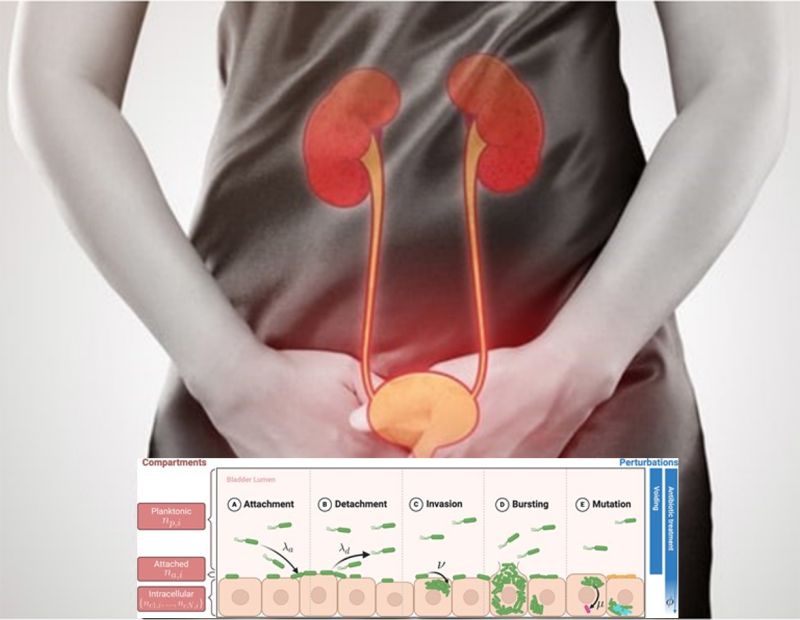
Our colleagues (Karolina Drabik, Bartlomiej Waclaw), in collaboration with Dioscuri German partner-the group led by Arne Traulsen from Max Planck Institute for Evolutionary Biology , have published a significant study on the ecological and evolutionary dynamics of urinary tract infections (UTIs). This work, leveraging a mathematical model, delves into the complex interactions between different bacterial populations within the bladder and their responses to physiological and therapeutic interventions.

📜 Study Highlights: UTIs remain a pervasive global health issue, largely due to the ability of pathogenic bacteria to adapt and persist within the urinary tract. Bacteria in the bladder exist in various states: planktonic (free-floating in the bladder lumen), attached to the bladder wall, and even within the bladder’s epithelial cells. Each of these bacterial populations encounters unique selective pressures—from the immune response and micturition to antibiotic treatments.

🔍 Key Findings:

Impact of Non-Planktonic Bacteria: The model reveals that non-planktonic bacteria (those attached or intracellular) significantly heighten the risk of infection establishment, altering evolutionary trajectories that can lead to antibiotic resistance.

Potential of Competitive Inoculation: Introducing a fast-growing, non-pathogenic bacterial strain was found to help curb pathogenic growth. This competitive approach increases the effectiveness of antibiotic treatment but hinges on careful moderation of antibiotic use.

This research underscores the importance of compartmentalized bacterial modeling in understanding UTIs. By accounting for the various niches bacteria occupy, the model provides a more realistic view of infection dynamics and suggests pathways for new treatment strategies.

Practice presentation session

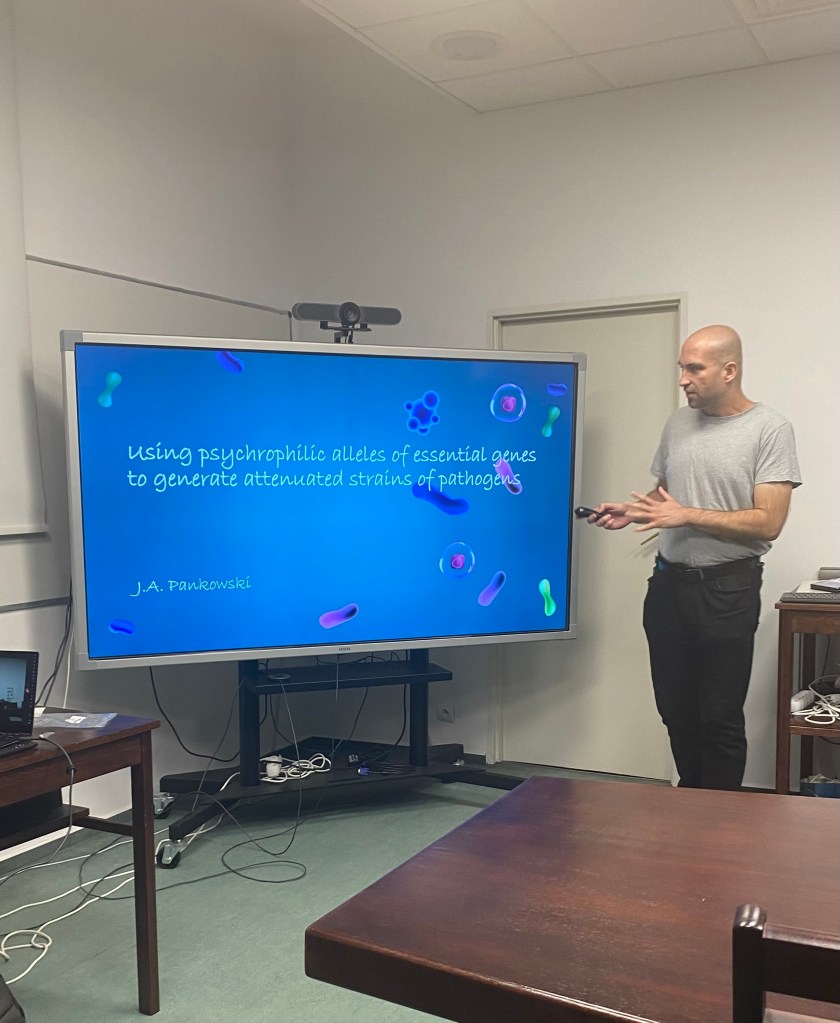
Yesterday, our research team had a productive practice presentation session, joined by our colleagues from the Dioscuri Centre for RNA-Protein Interactions in Human Health and Disease lead by Gracjan Michlewski. It was an insightful day filled with constructive feedback, stimulating discussions, and great camaraderie.

The session allowed our researchers to sharpen their presentation skills and refine their scientific content to be ready to show their work in the best possible light. We look forward to more such collaborations in the future!

Thank you to everyone involved for your dedication and support!

Our Polish-German meeting in Szczecin

Last week our Warsaw-based Dioscuri Centre travelled to Szczecin for a lab retreat and a meeting with our collaborators from Germany (Prof. Arne Traulsen, MPI Evolutionary Biology, Ploen). It was two intense days of research talks, discussions, and socializing. Despite our groups using very different approaches (theory in Ploen, mainly experiments in Warsaw), we were extremely pleased to see so many overlapping research interests.

We at the 27th Science Picnic!

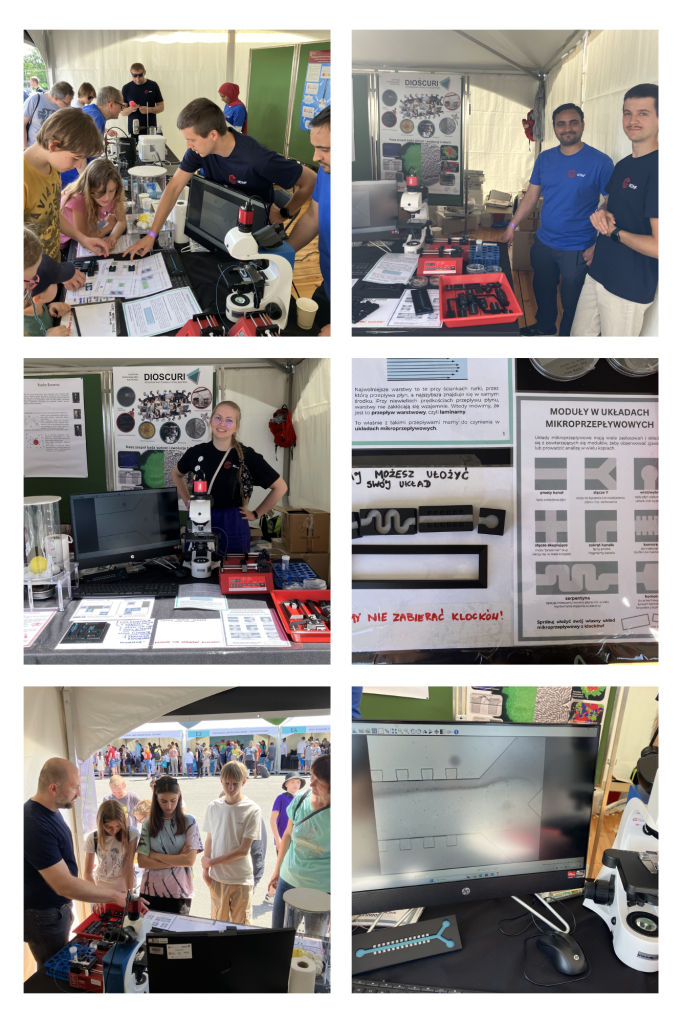
As announced, on June 15, 2024, we appeared at the 27th Science Picnic of Polish Radio and the Copernicus Science Center. Our stand could be visited from 11 a.m. to 8 p.m.
All visitors, including the youngest, were very enthusiastic about our “Extraordinary World of Microflows”, where they could learn about the key physical phenomena that determine the properties of flow on such small scale. Laminar flow, diffusion, and Brownian motion the Picnic participants observed on a large screen showing an image of a microfluidic channel under a microscope, they also learned how we prepare such systems in laboratory conditions, and they even created their own microfluidic systems from blocks. A puzzle referring to the construction of such systems from modules with blocks was very popular.

Thank you for your great interest and we are looking forward to the next edition of the picnic, which we will certainly be attending.