
Our colleagues (Karolina Drabik, Bartlomiej Waclaw), in collaboration with Dioscuri German partner-the group led by Arne Traulsen from Max Planck Institute for Evolutionary Biology , have published a significant study on the ecological and evolutionary dynamics of urinary tract infections (UTIs). This work, leveraging a mathematical model, delves into the complex interactions between different bacterial populations within the bladder and their responses to physiological and therapeutic interventions.
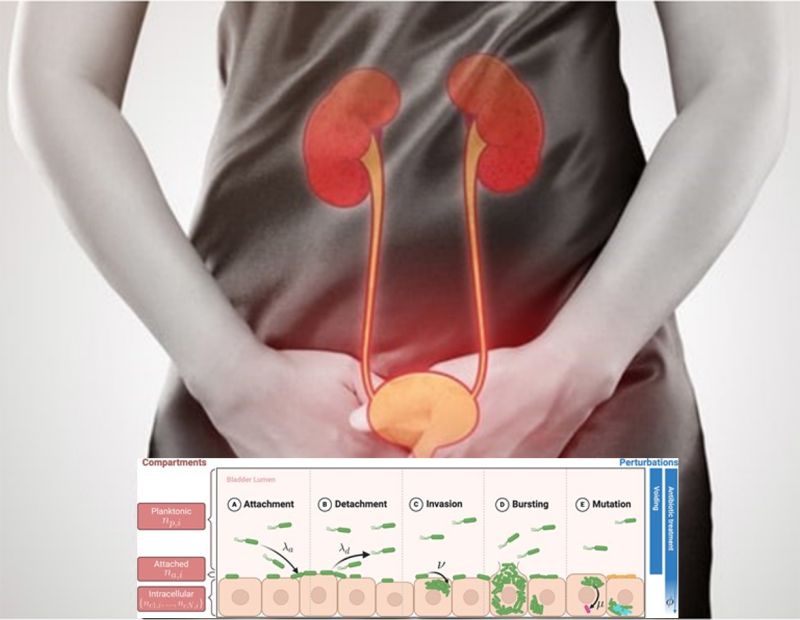
📜 Study Highlights: UTIs remain a pervasive global health issue, largely due to the ability of pathogenic bacteria to adapt and persist within the urinary tract. Bacteria in the bladder exist in various states: planktonic (free-floating in the bladder lumen), attached to the bladder wall, and even within the bladder’s epithelial cells. Each of these bacterial populations encounters unique selective pressures—from the immune response and micturition to antibiotic treatments.
🔍 Key Findings:
Impact of Non-Planktonic Bacteria: The model reveals that non-planktonic bacteria (those attached or intracellular) significantly heighten the risk of infection establishment, altering evolutionary trajectories that can lead to antibiotic resistance.
Potential of Competitive Inoculation: Introducing a fast-growing, non-pathogenic bacterial strain was found to help curb pathogenic growth. This competitive approach increases the effectiveness of antibiotic treatment but hinges on careful moderation of antibiotic use.
This research underscores the importance of compartmentalized bacterial modeling in understanding UTIs. By accounting for the various niches bacteria occupy, the model provides a more realistic view of infection dynamics and suggests pathways for new treatment strategies.
 Dioscuri Centre for Physics and Chemistry of Bacteria